The pioneer of a technical revolution
Tim Berners-Lee and the invention of the World Wide Web
Early on, Tim Berners-Lee became interested in computer technology, probably inspired by his parents. Mary Lee Woods and Conway Berners-Lee are renowned mathematicians who met at the work of Ferranti Mark I, one of the first commercially available universal computers. Tim graduated from London’s Emanuel School at the age of 17 and studied physics at the University of Oxford, where he completed his first self-built computer with an M6800 processor.
After completing his studies, Tim was able to take up work with the well-known companies Plessey Telecommunications Ltd. and D.G Nash Ltd. until he moved to Geneva in 1980 as a consulting engineer to the European nuclear research centre CERN.
There he saw himself confronted with an abundance of hypertexts, i.e. digital information files, in the company’s network and with differences in the computer network setup of the internationally distributed laboratories of CERN. From this problem, Tim developed an idea that would fundamentally change the understanding of globalization. He began working on the software Enquire, the pioneer of today’s World Wide Web (WWW). The function of this software was relatively simple. It should compress the company’s data abundance into a network and present it structured in a browser. Later Tim said about the World Wide Web:
Most of the technology involved in the web, like the hypertext, like the internet, multifont text objects, had all been designed already. I just had to put them together. (Most of the technology integrated into the web, such as hypertext, the Internet or multifont text objects, already existed. I just had to summarize it.)
He had to set work on this software aside when he returned to England in 1981 to work for Image Computer Systems. He returned to CERN in the mid-80s and in 1989 proposed expanding Enquire to improve the worldwide exchange of information between scientists.
In the early development phase, the well-known web components HTML, HTTP and URL were created. Also early on came the first web browser ‘WorldWideWeb’, whose name was later transferred to the complete project. The first web presence was established and still exists today (http://info.cern.ch) With the help of the still small number of users of the World Wide Web at that time, the system grew rapidly and could be expanded ever further.
Finally, Tim founded the World Wide Web Consortium (W3C) in 1994 to standardise techniques on the Internet, which he continues to chair. He started to make sure that the World Wide Web can be used by all people worldwide and does not split up into subwebs for commercial purposes.
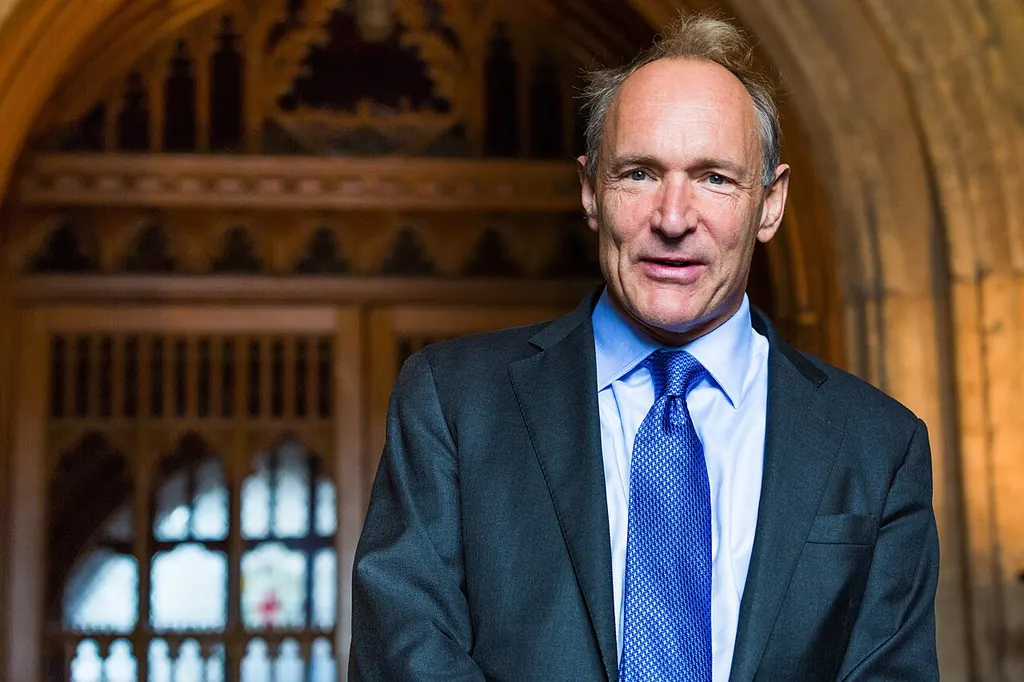

Today, the World Wide Web has become an almost essential part of our society, also because Tim has been so committed to universal accessibility. He was knighted by Queen Elizabeth in 2004. He has also been honored with many awards, including the Queen Elizabeth Prize for Engineering. Tim lives modestly compared to other modern technical inventors. He is still active in science and continues to fight for the public and free use of the Internet. For example, he is the president of the English non-profit organization Open Data Institute.
Tim Berners-Lee: Profile
- 8 June 1955: born in London. Parents: Mary Lee Woods and Conway Berners-Lee (both worked on the development of the Manchester Ferranti Mark I)
- 1969 - 1973: London’s Emanuel School
- 1973 - 1976: Physics studies at the University of Oxford in England
- 1976 - 1978: Plessey Telecommunications Ltd in Poole, UK
- 1978 - 1980: D.G Nash Ltd in Ferndown, UK as software developer
- June - December 1980: CERN in Geneva, Switzerland as a consulting engineer
- First work on Enquire started
- 1981 - 1984: Image Computer Systems in Bournemouth, UK as Director
- 1984: Return to CERN
- 1989: Start working on a program that simplifies the collection and structuring of hypertexts
- 1991 - 1993: Expansion and development of URI/URL, HTTP, HTML, etc…
- 1994: Establishment of the World Wide Web Consortium (W3C) to standardize techniques in the Internet/MIT automatically becomes the host institution of the W3C
- 1999: Chair of Laboratory for Computer Science
- 2003: Fusion of the Laboratory for Computer Science and the Artificial Intelligence Lab to Computer Science and Artificial Intelligence Laboratory
- 2003: ERCIM (European Research Consortium for Informatics and Mathematics) becomes the host institution of W3C
- 2004: Raised in the Knighthood of Queen Elizabeth
- 2004: Professor at the Computer Science Department of the University of Southampton
- 2006 - 2011: Co-Director of the Web Science Trust, a UK institution that promotes activities in the field of web science
- 2008: Professor of the 3Com Founders Chair
- 2008: Foundation of the WorldWideWeb Foundation, in which he becomes director
- 2011: Joined the Board of Trustees of the Ford Foundation
- 2012: Foundation of the Open Data Institute, of which he is president
- 2013: Queen Elizabeth Prize for Engineering for “the ground-breaking innovation in engineering that has been of global benefit to humanity”