PC Engine Hardware Add-ons
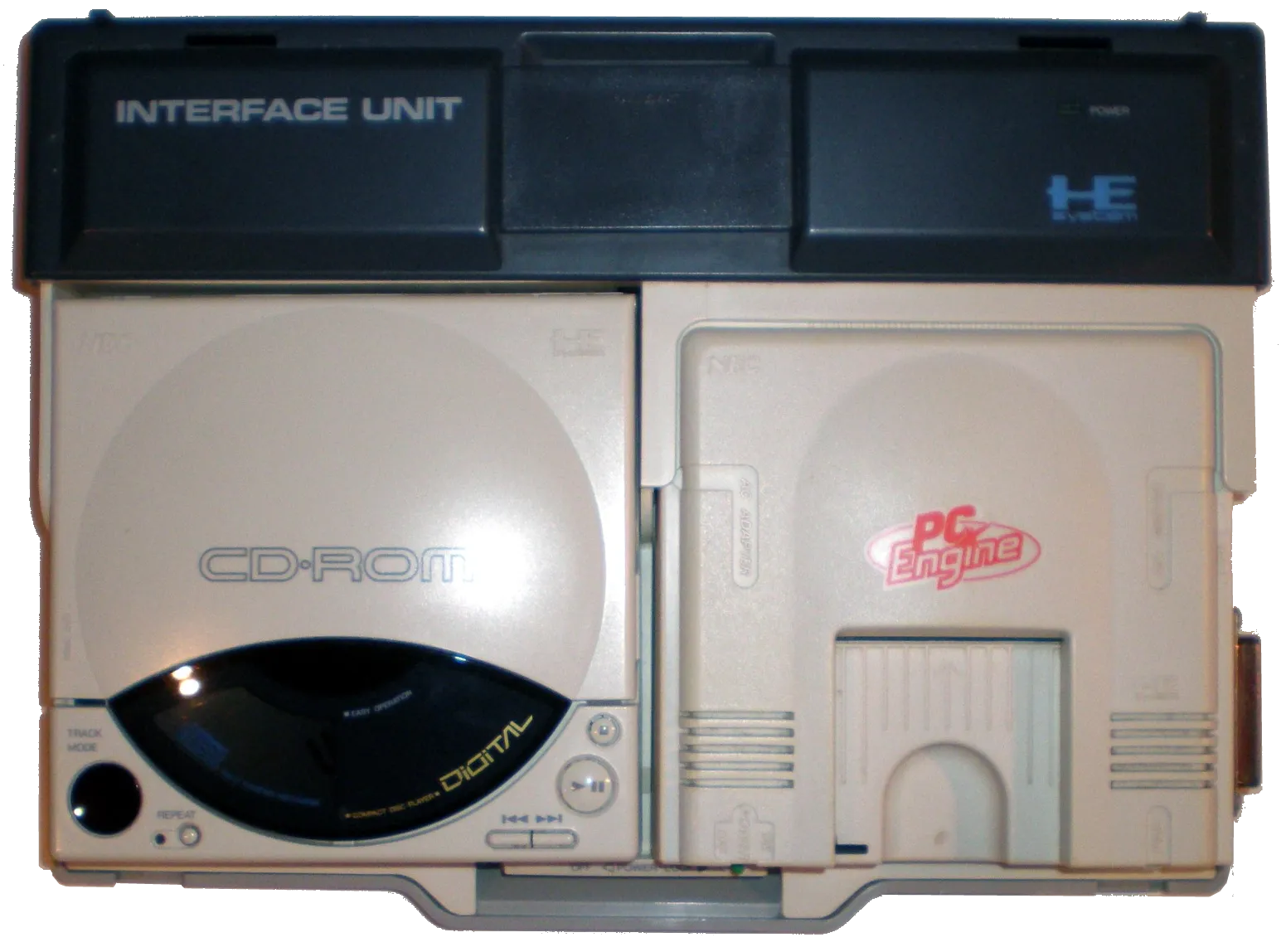
NEC and Hudson Soft released a whole range of accessories for the PC Engine. The most important hardware add-ons include various CD-ROM extensions, as many PC Engine versions can only play CD-ROM titles with them. In Japan, the first extension PC Engine CD-ROM² (pronounced: “CD ROM ROM”) was released in December 1988, enabling the PC Engine to play CD-ROM² titles and commercial audio CDs. The Japanese PC Engine CD-ROM² is about the same size as the console itself and kept in the same white grey. The add-on was available in Japan together with a kind of case carrier, in which PC Engine and hardware add-on can be accurately placed side by side.
In the USA, NEC and Hudson Soft sold their console as the TurboGrafx. Appropriately, the expansion released there in August 1990 was called the TurboGrafx-CD. Technically, it is no different from the PC Engine CD-ROM². Like the TurboGrafx itself, however, the add-on is black and much bulkier than its Japanese counterpart. Connected to the console, it therefore looks quite different.
In December 1991, NEC and Hudson Soft released another CD-ROM add-on: the Super CD-ROM² System. It plays both ordinary CD-ROM² titles and the newer Super CD-ROM² titles. Japanese players had two ways to obtain this functionality. Those without a CD-ROM add-on could buy the Super CD-ROM² directly. Owners of the original CD- Rom² expansion could instead purchase a Super System Card. With this card, the CD ROM² gains the same hardware capabilities as the Super CD-ROM² and can play the same Super-CD-ROM² titles.
In the USA, such an independent, second CD-ROM add-on did not appear. The PC Engine Turbo Duo, which was released there a little later, is able to play both CD-ROM versions. In addition, the decision was made to release a Super System Card in the USA, which later enabled the TurboGrafx CD to play Super CD-ROM² titles. To make this option particularly tempting for US consumers, NEC and Hudson Soft added a 4-in-1 SuperCD to the Super System Card. This included four games that make use of the improved technical capabilities of Super CD-ROM² technology.
One of the final hardware updates was the Japan-only Arcade Card, released by NEC and Hudson Soft in March 1994. It supports a third CD-ROM format, Arcade CD-ROMs². The Arcade Card further expands the PC Engine’s memory and pushes the console’s capabilities to their limit. Few games used it, but its importance for sprite-heavy 2D titles should not be underestimated. The racketboy.com PC Engine guide (see links) describes its legacy: “One of the most graphically impressive shooters of the 16-bit era and some of the best 16-bit console ports of Neo Geo fighting games are the expansion’s legacy.” NEC and Hudson Soft sold two versions: Pro for the original CD-ROM² add-on, and Duo for the Super CD-ROM² add-on and all PC Engine Duo models. Unlike HuCard games, all CD-ROM titles are region-free. With the appropriate CD-ROM add-on or System Card, players can therefore run any CD-ROM title on their system.
In addition to the CD-ROM add-ons, a number of other PC Engine accessories have appeared over the years. With the exception of the US Turbo Duo system, Japanese and US consoles from NEC and Hudson Soft use different gamepad ports. Corresponding converters are among the standard accessories among dedicated PC Engine fans.
Since all PC Engine or TurboGrafx versions only have one gamepad connector each, the TurboTap is essential for multiplayer fans. Up to five players can participate in multiplayer games via TurboTap, for example in titles such as Bomberman.
The TurboStick is specially designed for use with beat-em-up and 2D shooter titles, such as Street Fighter II: Champion Edition and Blazing Lazers. There are also several gamepads, which are equipped with more than the standard two action buttons. These often appeared along with titles that explicitly make use of this action button variety. Like the Super CD-ROM² title Forgotten Worlds, which was released together with the NEC Avenue Pad 3.
The AV Booster later equips the original Japanese model of the PC Engine with an AV output. Under the name TurboBooster, this extension was also available in the USA. The Japanese hardware devices Tennokoe Bank and Tennokoe 2 can be considered as precursors of classic Memory Cards. Under the name TurboBooster Plus a similar device appeared in the USA.
Connections in the collection
In the exhibition concept
- The PC Engine · Area Konsolen 2, Section 5