NDR Small Computers

Summary
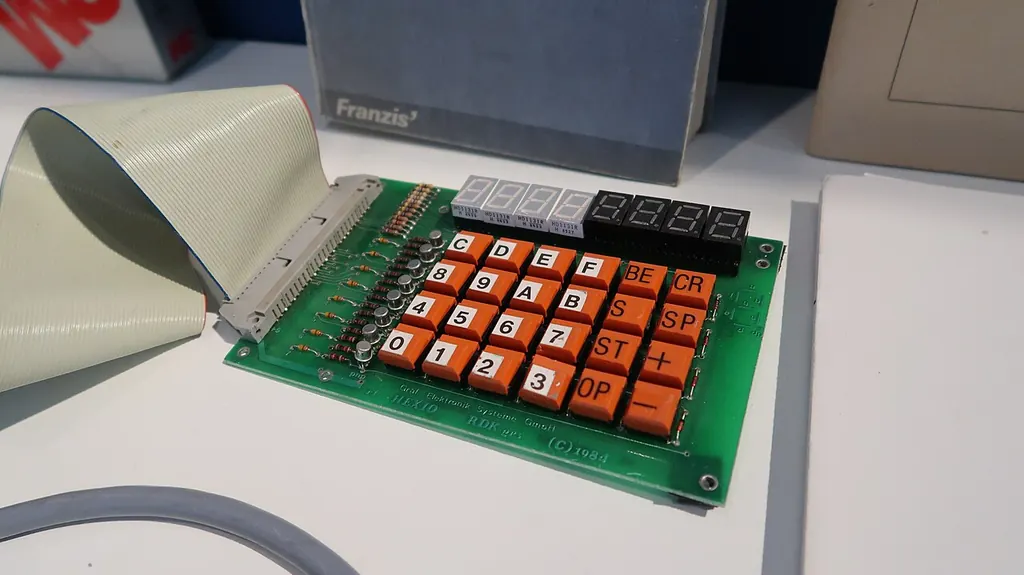
In 1984, NDR’s schools television service, led by Joachim Arendt, broadcast the 15-minute series “Einführung in die Mikroelektronik”, also known as “NDR – Klein Computer”. Bavarian television’s third channel later repeated it. Presenter Thomas Naumann is now better remembered for his role as a country doctor. Across 26 instalments, the series explained how to build the “NDR-Computer R.-D. Klein”, or NDR – Klein Computer (NKC). It began with electrical circuits in “Folge Null” and progressed to a home computer and applications, ending with “Straßenbau” in episode 26. Its teaching approach centred on modules plugged into a baseboard: memory, keyboard interfaces, EPROM programming hardware and more. This made the computer highly modular and expandable.
Rolf-Dieter Klein, then employed at the Technical University of Munich, played a central role in planning the series. Industrial projects had introduced him to modular systems, and from 1978 he published books including “Mikrocomputersysteme”, “Mikrocomputer, Hard- und Softwarepraxis” and “Mikrocomputer selbstgebaut und programmiert” (1983). One reached NDR and led to their collaboration. Klein and director Martin Ulrich wrote the scripts in 3 months. Klein simultaneously updated “Mikrocomputer selbstgebaut und programmiert: Vom Bauelement zum fertigen Z80-Computer” (Franzis Verlag, 2nd edition, 1984). He and other authors later contributed NKC articles and special issues, including the “Mikroelektronik im Fernsehen” series in mc magazine. In 1987, his book “Rechner modular. Der NDR- Klein- Computer, selbstgebaut und programmiert” covered the POW5V, SBC2, Z80CPU, CPU64180, ROA64, BANKBOOT, GDP64K, IOE, CAS, SER, PROMER and FLO2 modules. More books followed. Franzis Verlag also released the television series on videocassette.
Etching circuit boards and buying every component was not for everyone, so Graf Elektronik Systeme GmbH (GES for short) in Kempten and Elektronikladen in Detmold offered complete NKC kits. GES supported the series from its launch and published practical advice in its customer magazine LOOP from 1984 to 1991. Rolf-Dieter Klein joined the editorial team alongside company founder Gerd Graf. The kit and its thorough documentation provided an excellent introduction to microcomputers, and the kits were also used in education, including at the technical school of the German postal workers’ union. Add-ons such as the Fischertechnik robotics kit extended the teaching possibilities. The computer therefore remains attractive for educational use.
Sources and further links
Keywords
Acquire the complete collection.
The collection is offered as a whole. The inventory lists show which objects are included.