Sega Visual Memory Unit/System (VMU) for Dreamcast
Summary
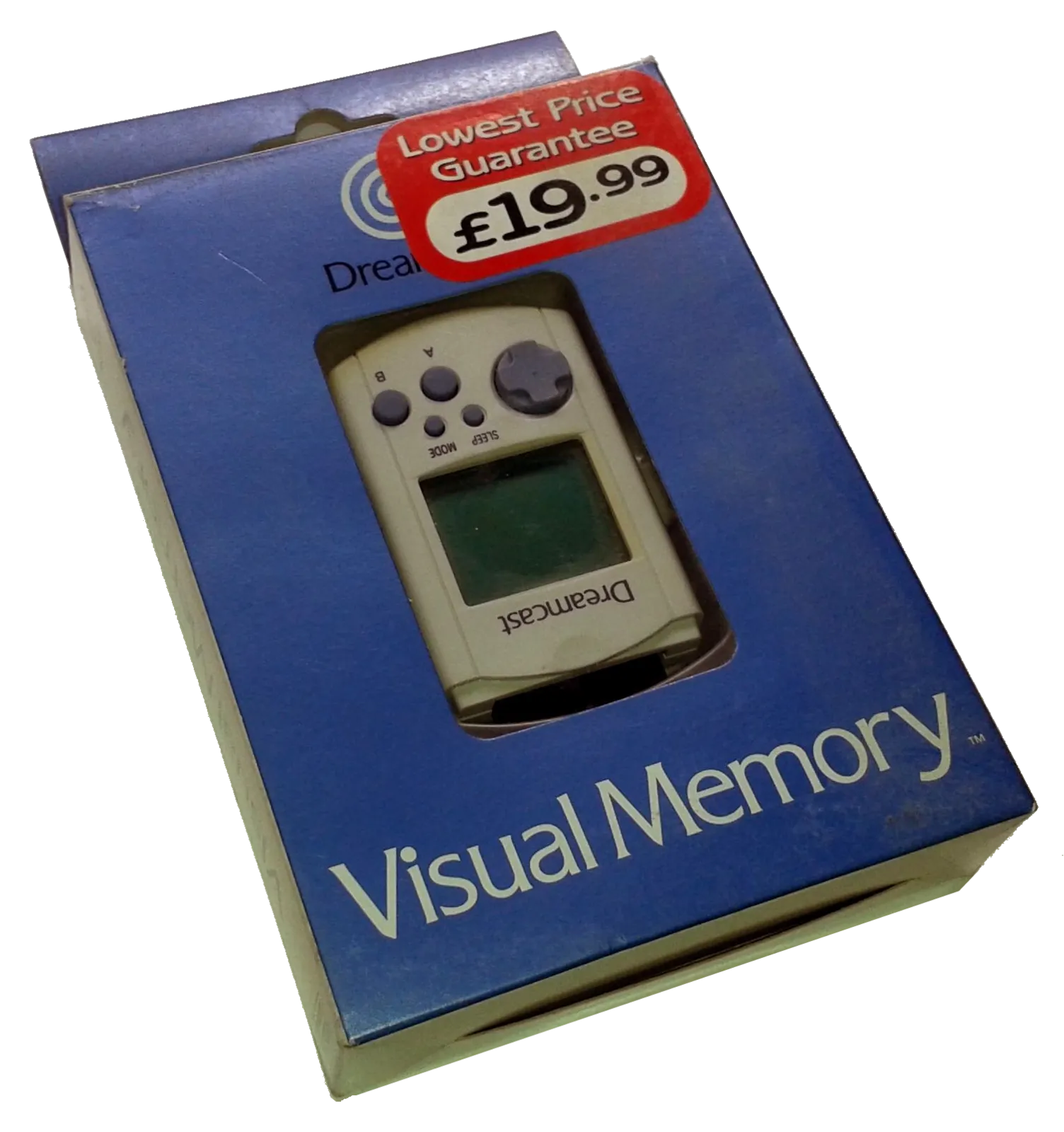
It is rare that the name of an extension (Memory Unit) and its appearance vary. The Sega Visual Memory Unit (VMU) is a permanent memory for the Dreamcast with 128 KiB, but according to its appearance it is rather a mini game console, because it has a black and white LCD display with 48 × 32 points, speakers, control pad and four buttons.
As flash memory, the VMU is plugged into one of the two slots of a Dreamcast controller; two VMUs can be active at the same time. Only the display remains visible in the controller, and the small buttons are hidden. The so-called in-game features are shown — usually a simple image or animation, rarely even status information or options. With 128 KiB, the memory is not exactly large and it can happen that some game titles catch almost the entire memory for saved games and then the memory is full. Exciting is the possibility to use the VMU as its own game console, because minigames can be installed. Two VMUs can also be combined, allowing data to be exchanged. Two CR2032 button cells are required for the current.
In Japan, the expansion came into the market in 1998 under the name “Visual Memory System (VMS)”, in North America in 1999 as — to avoid problems with the already registered trademark VMS — “Visual Memory Unit (VMU)”, in Europe it is called “Visual Memory (VM)”. VMUs of different colours and designs will follow in the coming years. Some issues bundle the VMU with small toy figures. Later, the memory increases and there are issues without a display, such as the Sega 4x Memory Card. Third-party manufacturers also release memory extensions. After the expiry of the Dreamcast, there are still hobby developers programming for the VMU minigames today.
Picture: http://upload.wikimedia.org/wikipedia/commons/9/9a/Sega-Dreamcast-VMU.jpg

Sources and further links
Connections in the collection
In the exhibition concept
- Generation 6 · Area Konsolen 2, Section 11
Mentioned in
Keywords
Acquire the complete collection.
The collection is offered as a whole. The inventory lists show which objects are included.