Sega Dreamcast

Summary
The Dreamcast is the first released console of the sixth generation. It is also the last console produced by Sega and marks the end of an era.
After the little-supported Mega-Drive extensions Sega CD and 32X and the unsuccessful Saturn, Sega has a hard time with developers and potential customers. In the first year, the sales of Dreamcast are nevertheless promising until Sony then rolls over the market: ten months after the introduction of the PS2, Sega announces that the Dreamcast will be discontinued, that no more consoles will be produced and that in future it will focus on the production of software for the former competitors.
Despite its weak sales, the Dreamcast is now regarded as an excellent machine ahead of its time. It is based on cost-effective standard chips, is attractive to developers through a Windows system licensed by Microsoft and is designed for online gaming years before the XBox.
Detailed description
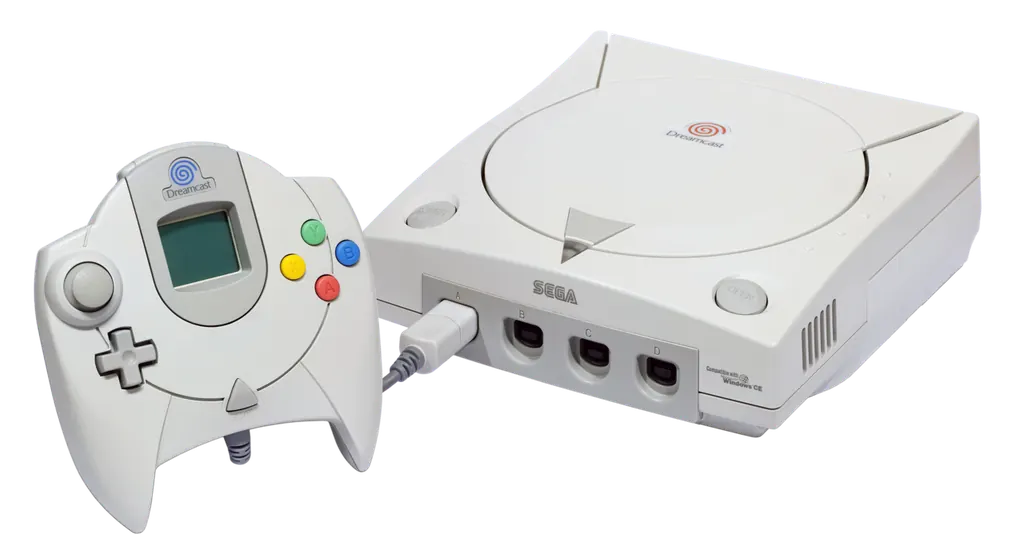
The Sega Dreamcast is the first game console with a high-performance CPU and 128-bit FPU as well as online capabilities (this should also be expressed by the spiral logo). On the symbolic 09.09.1999 it was introduced in North America, a few weeks later in Europe. In Japan, the Dreamcast has been on the market for almost a year at this time. The case features a “Compatible with Windows CE”, as Microsoft ported the Windows CE to the Dreamcast, allowing developers to use this operating system. After the less successful consoles Saturn, 32X and Mega-CD Sega had a good product with a rocket launch, but the Sony PlayStation 2 had a comparable performance and a DVD drive. In addition, the Dreamcast suffered from a strong lack of games.
For several reasons, the Dreamcast is a system worth considering both in terms of Sega’s career and the general market for game consoles. The weak market presence of the console ensures that Sega stops production after a good three years and a little more than eight million devices sold. Instead of designing a successor, the failure of the Dreamcast resulted in Sega withdrawing completely from the hardware market. Since then, only software has been developed for the systems of other manufacturers. Curiously, this resulted in a scenario that seemed unthinkable a few years earlier: titles with the Sega mascot Sonic, established as “cool” equivalent to Nintendo’s mascot Super Mario in the course of Sega’s earlier marketing, now also appear for Nintendo systems. For the Nintendo GameCube there is even an implementation of Sonics Dreamcast title Sonic Adventure 2.
Furthermore, the Dreamcast is considered to be a video game console, which with its functions was simply ahead of time. By default, the Dreamcast includes a modem for online functions, so Sega is expanding its online service even further. For the launch of the Dreamcast in Japan, the servers are sometimes even overloaded. Years before online services such as Xbox Live or PlayStation Network should become standard, the Dreamcast offers a comparable service. However, the already mentioned commercial failure of the console causes Sega to deactivate the servers in 2003.
The Dreamcast supports a range of unusual accessories. Similar to the gamepad of the Nintendo 64, a memory card could be inserted into the gamepad of Segas console. With this, however, it is not only possible to secure game levels. Sega equips the memory card called Visual Memory with its own display and action buttons. Some games use this additional screen, for example for status displays. Two objects are to be highlighted within the bar of the unusual accessory. For fishing simulations, as they are quite popular in Japan, third-party manufacturer Mad Catz released the so-called Fishing Controller. He is modeled in his form of a real fishing rod. For the music game Samba de Amigo not only appeared a dance mat, but also a Maraca set. This required the player to shake them in the correct rhythm to the music of the game.
Due to its exotic or cult status, the Dreamcast has such a loyal “hardcore” fan community around itself that even after its production new games always appear. These come mainly from the classic shooter genre, such as Last Hope (published in 2007) or NEO XYX (published in 2014). In particular, a look at the trade press reveals that the Dreamcast is probably one of the most underestimated consoles: the online magazine IGN leads them to eighth place in its “Greatest Video Game Console Of All Time” list; the trade magazine EDGE placed them in tenth place in a similar list in 2013. This is quite amazing for a console that could not even reach the sales dimensions of a PlayStation 2 with a sales volume of eight million units (about 155 million sold consoles).
Historical retail price
29,800 Yen (approximately, adjusted for inflation: 200 €).
Japan, November 1998. Japanese standard model of the Dreamcast.
Purchasing-power comparison at September 2026 prices; exchange rate dated 27 October 2026. Calculation and data sources.
Family tree
- PredecessorSaturn
- This objectDreamcast
Sources and further links
Connections in the collection
Software in the collection
- Sega Dreamcast Games and Software · 17 titles
In the exhibition concept
- Generation 6 · Area Konsolen 2, Section 11
Mentioned in
Keywords
Acquire the complete collection.
The collection is offered as a whole. The inventory lists show which objects are included.