Sony PlayStation 2 (PS2)
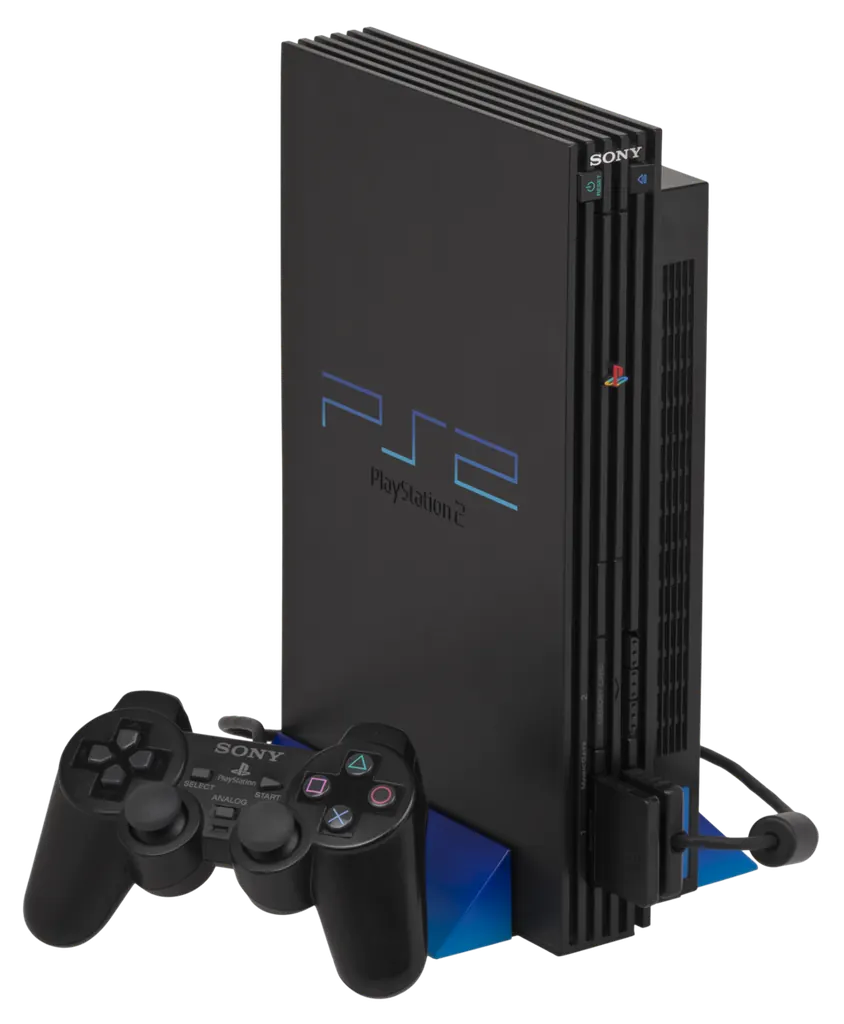

Summary
Although the available games initially reap average reviews, three factors contribute decisively to the success of the PS2: After Sega has stopped producing the Dreamcast, the PS2 is the only sixth generation console on the market for months. It is also backwards compatible with almost all PlayStation games, and for many users it is the first own DVD player.
The PS2 is produced for 13 years and is the most commercially successful console of all time with 155 million units sold. Overall, as already on PlayStation, about 2500 games appear.
The PlayStation 2 consistently continues the path from a pure game console towards a multifunctional entertainment system. This is especially due to the fact that it can play video DVDs. Game series such as EyeToy and SingStar ensure that Sony’s system enjoys great popularity even with casual players.
Detailed description
The PlayStation 2 is the successor console of Sony’s PlayStation and belongs to the sixth generation of consoles. Together with the systems of Microsoft, Nintendo and Sega, PlayStation 2 fought around the turn of the millennium for the favor of the buyers and emerged from this competition as the winner. This is due to several factors. These are based not only on Sony’s clever decisions, but also on strong third-party support and competition errors.
The PlayStation 2 went the way from a pure game console towards a multifunctional entertainment system consistently. This was especially due to the fact that it can play video DVDs. Game series such as EyeToy and SingStar ensured that Sony’s system enjoyed great popularity even with casual players. Ultimately, it should prove to be even more successful than its predecessor: worldwide Sony sold about 157 million PlayStation 2 systems.
When PlayStation 2 was released in spring 2000 (the US and Europe releases were scheduled to be released at the end of the same year), Segas Dreamcast had already opened the sixth generation of consoles. At that time, the Dreamcast was on the market for almost two years and technically was about the same with PlayStation 2. A little later, Nintendo’s GameCube and Microsoft joined the competition with Xbox. In particular, the latter was superior to the PlayStation 2. However, this should not change the fact that Sony’s console should prevail over the entire system competition period.
One component of the success is certainly the programming of PlayStation 2 titles. Although the graphics processor lacked a dedicated Vertex shader, which is designed to represent particularly complex 3D models. But the 300 MHz fast main processor of the console, which is called “Emotion Engine”, has two additional vector processors. These auxiliary processors of the main processor could be programmed very freely by the developers. In combination with the fact that many developers primarily supported Sony’s system in the previous generation of consoles and maintained this idea with the newly introduced PlayStation 2, the console already enjoyed strong support from the developer studios for launch.
This was reflected in PlayStation 2 sales. Although Sega’s Dreamcast eventually became a commercial failure, it had enjoyed an impressive launch. The PlayStation 2 matched that success: Sony sold almost a million PlayStation 2 consoles in Japan within 24 hours of launch. The US and European launches were similarly successful. Sega stopped producing the Dreamcast in spring 2001, while the Xbox and GameCube were not yet available, so for several months the PlayStation 2 was the only sixth-generation console on sale.
Sony offered PlayStation 2 to market at a price of just under $300. It was more than $100 more expensive than the GameCube and was at the same price as the Xbox. But Sony benefited from three wise decisions. On the one hand, the company provided PlayStation 2 with downward compatibility. This allowed all PlayStation games to be played with the successor console. Second, players were able to continue using the DualShock Gamepad of the first PlayStation. In addition, PlayStation 2 was able to play video DVDs by default. The Xbox had to be retrofitted for this playback function, on which GameCube it was not even possible due to hardware. At a time when the DVD medium was comparatively new, PlayStation 2 therefore cost only slightly more than a DVD player. Many customers therefore took the same approach to Sony’s product. The game console and player of the latest medium found themselves united in a device next to the home TV.
Sony’s own studios and third-party developers continued many successful series that had made their debut, sometimes exclusively, on the PlayStation with new releases for the PlayStation 2. Many players welcomed this familiar mix of sports simulations, fighting games and tactical or action-oriented shooters. Tekken, Gran Turismo, Grand Theft Auto, Kingdom Hearts, Metal Gear Solid, Final Fantasy and God of War were among the particularly successful series.
The PlayStation 2 also met with appeal outside the ranks of the “hardcore” players, as Sony relaxed the software library imaginatively. The console could be connected to a camera called EyeToy. Corresponding titles were based on a control that required a player’s own movement (also called Motion Control). The SingStar series of games also transferred the karaoke concept to PlayStation 2. In not a few households, it functioned as a “party console”. Overall, the PlayStation 2 software library includes a good 3800 games plus the already extensive software range of the first PlayStation.
When the Xbox successfully introduced the well-organised paid online gaming service Xbox Live in late 2002, Sony took a different approach. It did not launch a centrally organised equivalent, instead leaving online servers to individual publishers. PlayStation 2 players lacked some convenience features, but online play remained free.
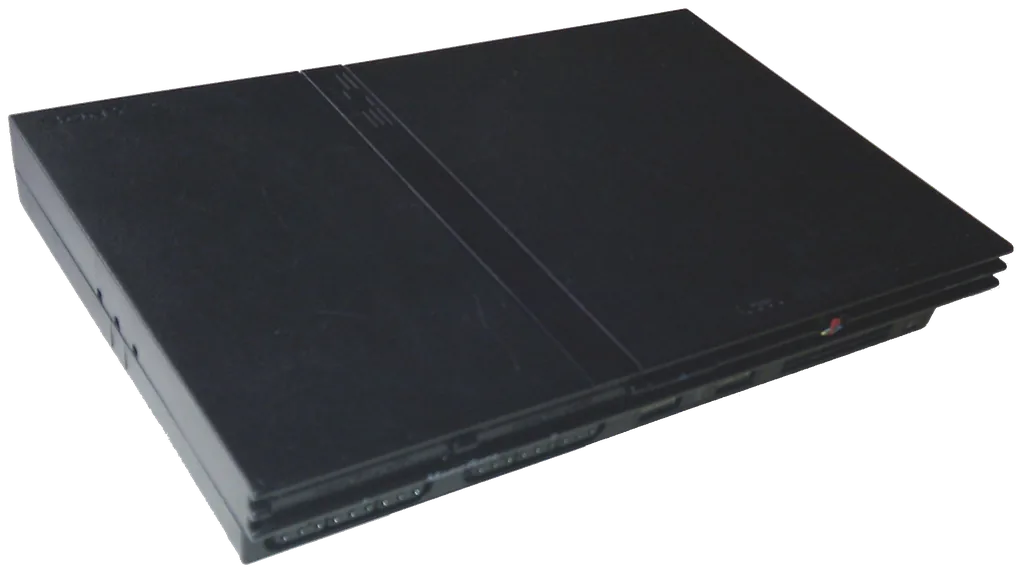
The original PlayStation 2 required a separate adapter for online play. In autumn 2004, Sony released a revised version with the network adapter built in. It is smaller, slimmer and quieter than the original, but does not support an external hard drive. Since a few games require one, some fans strongly criticised this decision. It did little to diminish the console’s enormous popularity, which Sony sustained with further colour variants, including white, silver, gold and pink.
The PlayStation 2 was released from Sony’s production halls until 2013. For several years, the company produced them analogously to its successor system, PlayStation 3. The PlayStation 2 is one of the longest-produced and actively supported video game consoles in history.
Historical retail price
299 US dollars (approximately, adjusted for inflation: 520 €).
USA, October 2000. US launch of the original PlayStation 2 series.
Purchasing-power comparison at September 2026 prices; exchange rate dated 27 October 2026. Calculation and data sources.
Family tree
- PredecessorPlayStation
- This objectPlayStation 2
- SuccessorPlayStation 3
Sources and further links
Connections in the collection
Software in the collection
- Sony PlayStation 2 (PS2) Games and Software · 254 titles
In the exhibition concept
- Generation 6 · Area Konsolen 2, Section 11
Mentioned in
Keywords
Acquire the complete collection.
The collection is offered as a whole. The inventory lists show which objects are included.