Sony PlayStation (PS1)

Summary
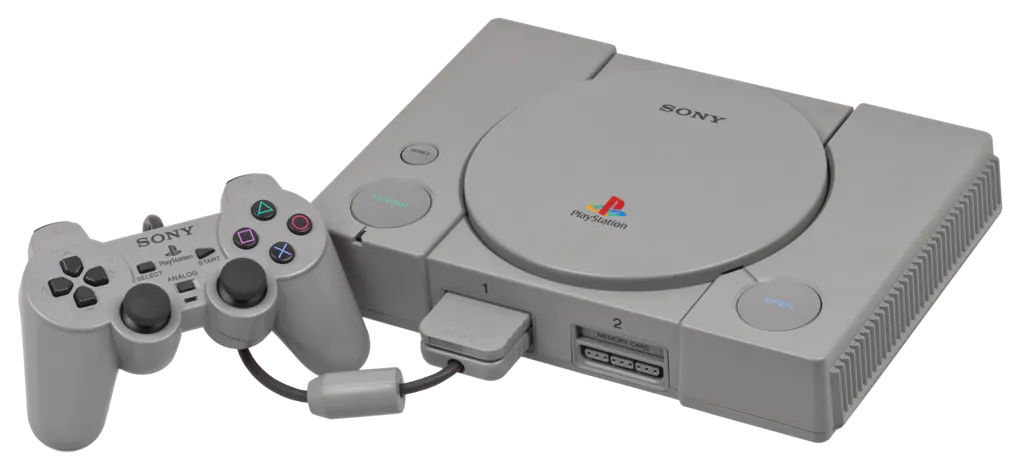
After the collaboration between Sony and Nintendo failed to develop a CD-ROM extension for the Super Nintendo, Sony decides to build its own video game console. The name PlayStation is retained, but the architecture goes far beyond the specifications of an SNES.
The success of 3D arcade games released by Sega during this time convinces Sony to rely on 3D graphics. This leads to a different feeling of playing and sets the PlayStation clearly off previous machines.
Although Sony is new to the console business, and even though PlayStation is different in its approach to gaming from other consoles, success is sweeping and makes the new competitor a major industry player to this day.
Not least, because Sony massively supports third-party software development, about 2500 games appear together, more than for Mega Drive and SNES.
Detailed description
Sony Computer Entertainment’s PlayStation is one of the world’s best-selling gaming consoles. The first generation PlayStation (also called PS1 or PSX) marked the beginning of Sony’s success story as a console manufacturer.
In the middle of the competition of the fifth generation of consoles, which began in the mid-1990s, the PlayStation is clearly the winner. The PlayStation sells more than 102 million copies, which the competitors from Sega (the Saturn) and Nintendo (the Nintendo 64) cannot achieve. A large software library, clever marketing and a comparatively simple conversion of the PlayStation are other aspects that contribute to the success of the console.
A later update version called PSone helps the console to achieve an additional boost of popularity at the end of its life cycle.
The immense success is due to several factors. On the one hand, it is certainly due to the comparatively low start price of the console: in the USA, it costs about USD 100 less than Saturn, at just under USD 300. In Japan alone, Sony will sell two million devices in the first six months of its launch. With PlayStation, Sony has released a product that benefits directly from its strong technology, comparatively simple programming and very extensive support from the developers when it comes to starting its market affiliation. For example, Squaresoft, which supported Nintendo for years with its final fantasy episodes, releases Final Fantasy VII exclusively for PlayStation. The game was originally planned for the SNES and then the Nintendo 64. However, most of the developers see PlayStation’s CD-Rom format as the leading medium of the next few years, so that not a few studios focus on Sony’s console.
At the launch of PlayStation, Sony was also deliberately marketing its console as a lifestyle product and targeting a consciously older clientele. The PlayStation is to be perceived as a “cooler” and “harder” equivalent to Saturn and Nintendo 64. The futuristic racing game Wipeout, the Beat’em-Up Battle Arena Toshinden and the first-person shooter Kileak The Blood (all part of the launch line-up) clearly show which direction Sony’s new system should take. This claim will be underlined in the coming years with (exclusive) titles or series such as Driver, Metal Gear Solid, Crash Bandicoot, Tomb Raider, Tekken and Gran Turismo. In total, more than 7900 different games are released for PlayStation. This corresponds to a much more extensive software library than the one that is granted to its competitors. The Nintendo 64 looks back on a total of about 400 titles, the Saturn on about 600.
However, PlayStation enjoys a high reputation not only because of its lifestyle status, but also because of its high quality and quantitative software selection in the favor of players. The original gamepad was reworked in 1997 by Sony with two analog sticks. As a result, even first person shooters with the PlayStation are very well playable. In addition, games that often suffer from camera perspective problems can be adjusted more comfortably in certain game situations. This applies especially to 3D jump’n’runs and action titles that build on a third person view.
In addition, with the introduction of PlayStation, especially thanks to the CD-Rom-medium, the modding scene is now explicitly dedicated to the area of game consoles. It is comparatively straightforward to have the PlayStation equipped with a Modchip (questionable from a legal point of view). So it is no longer necessary to use cumbersome “plug-on converters” as the SNES still requires to play games from Japan or the USA. Especially players, who want to receive their favourite titles before a European release date, grab Sony’s console. In hindsight, the fact that Sony was originally working with Nintendo on a disk drive for the SNES is all the more bizarre. However, since the collaboration is terminated prematurely before the release of such a drive, Sony is dedicated to the development of a console, which should finally result in that same PlayStation.
In addition to the original PlayStation model, Sony released a revised version called PSone in 2000. This differs in several features from the first model. It has no dedicated “reset” button and no serial interface on the back, is much smaller and more rounded and has a graphically revised system menu. Furthermore, due to the small size and simultaneous restructuring of the internal hardware setup, it is now more difficult to equip the PSone with a modchip. Sony is still producing the PlayStation until the end of 2005, so it runs parallel to its successor, PlayStation 2, for several years.
Family tree
- This objectPlayStation
- SuccessorPlayStation 2
Sources and further links
Connections in the collection
Software in the collection
- Sony PlayStation 1 (PS1/PSX) Games and Software · 272 titles
In the exhibition concept
- Generation 5 · Area Konsolen 2, Section 9
- Generation 7 · Area Konsolen 3, Section 2
Mentioned in
Keywords
Acquire the complete collection.
The collection is offered as a whole. The inventory lists show which objects are included.