Commodore Magic Voice Speech Module for C64

Summary
Voice output on computers has a long tradition. Before the computers were powerful for a software solution and offered good audio playback, it was hardware extensions that enabled voice output. In 1976, Paul Breedlove, Richard Wiggins, Larry Brantingham and Gene Frantz started to test how compactly human language can be recorded, with a budget of USD 25,000. The project was successful and resulted in the development of the electronic toy Speak & Spell, which brought Texas Instruments to the market in 1978. In addition to the feature that Speak & Spell was one of the first games with a display and replaceable modules, the voice synthesizer deserves special attention. TI continued to conduct research in the direction and also developed accessories for its own TI-99/4A home computer.
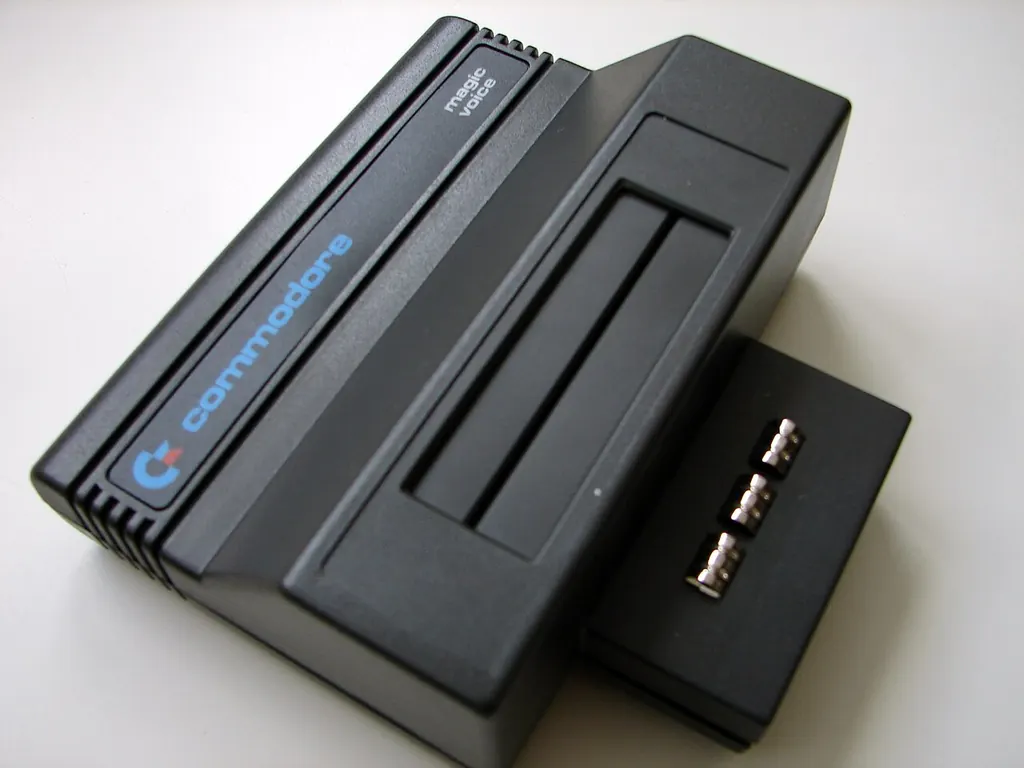
Commodore was interested in this voice output and hired Richard Wiggins from TI and made him the head of a development team of the newly founded “Speech Technology Division” in Texas. There the team worked on a plug-in module with voice output, which resulted in the Magic Voice Speech Module. The result was impressive for the time. Using the Linear Predictive Coding (LPC) method, the module placed a vocabulary of 235 words on 128 KiB. Saving words was rather unusual, because often voice output systems put recorded phonemes in a row that shape words. But Commodore wanted to use the system in teaching, and that was not possible without an excellent voice output: “Education is one of the major uses we forsee for the Magic Voice”. Thus, the team chose frequently used words of the English language – enriched with IT terms such as “cursor” or “disk” – and had everything read by a professional speaker along with letters and numbers. A woman was deliberately chosen as a speaker, as cognitive studies show that preschoolers use a female voice to better absorb material. After recording, the audio recording was digitized, analyzed, processed, compressed and burned to ROM.
The module plugs into the Commodore 64 cartridge port and passes the connections through, allowing another cartridge to sit on top in a piggyback arrangement. Audio connectors route the C64’s sound into the module, mix it with speech and send the combined signal to a stereo system. The module can be controlled from machine code or BASIC. Its new BASIC commands do not reduce the memory available to BASIC programs, but machine-code programmers lose 1 KiB because it reserves $C000-$C3FF. The main BASIC command is SAY, for example SAY “YES”:SAY “HELLO”. Each word also has an index, so SAY 157 is equivalent to SAY “YES” and saves memory. The manual lists the words and their indices. An unavailable word produces a ”?ILLEGAL QUANTITY ERROR”. The routine does not split strings into words: “GOOD MORNING AMERICA” requires three separate SAY commands. Speech is generated alongside the BASIC program, and the RDY variable indicates whether output is in progress. RATE controls speed, from the slower RATE #1 through normal RATE #4 to the fastest RATE #10. Faster playback does not raise the voice to a high-pitched Mickey Mouse sound.
Commodore had ambitious plans for the speech module, but interest soon faded. The company contributed to this by promising expansions that never appeared, including additional vocabulary and male or child voices. A disk was supposed to provide 10,000 words. Only three products supported the module: the games Gorf and Wizard of Wor, and the children’s learning program A Bee C’s. Gorf could say “Survival is impossible”, while Wizard of Wor included “I’m the Wizard, not you!”. In the games, speech was an optional extra that used only a fraction of the module’s capabilities; the educational program required it. All three products came from Commodore, and no independent developers adopted the expansion.
Own extensions were not easy, because the 235 words are not enough, there is a problem; a phoneme collection is not integrated in the ROM. Only spelling remains here, but the result is, of course, unsightly. In part, more words can be inserted by taking into account that “sea” and “see” are pronounced alike, i.e. they are homophones. That’s good, because “see” is present in vocabulary, but “sea” is not. The same applies to “gray” (not present), which can be replaced by “grey”. Other ideas that can be solved by an exchange program: “bee” by means of “b”, “eye” by means of “i”, “knot” by means of “not”, “pea” by means of “p”, “queue” by means of “q”, “tea” by means of “t”, and also the numbers and a few mathematical special characters can be spoken like this.
Commodore was not the only company offering speech synthesis. Adman Electronics, Ltd. in the UK sold the phoneme-based VIC-20 Speech Synthesizer; the Alien Group offered Voice Box for the VC-20 and C64; and another option was the Covox Voice Master Speech Synthesizer.
Sources and further links
Keywords
Acquire the complete collection.
The collection is offered as a whole. The inventory lists show which objects are included.