IBM Personal Computer 5150

Summary
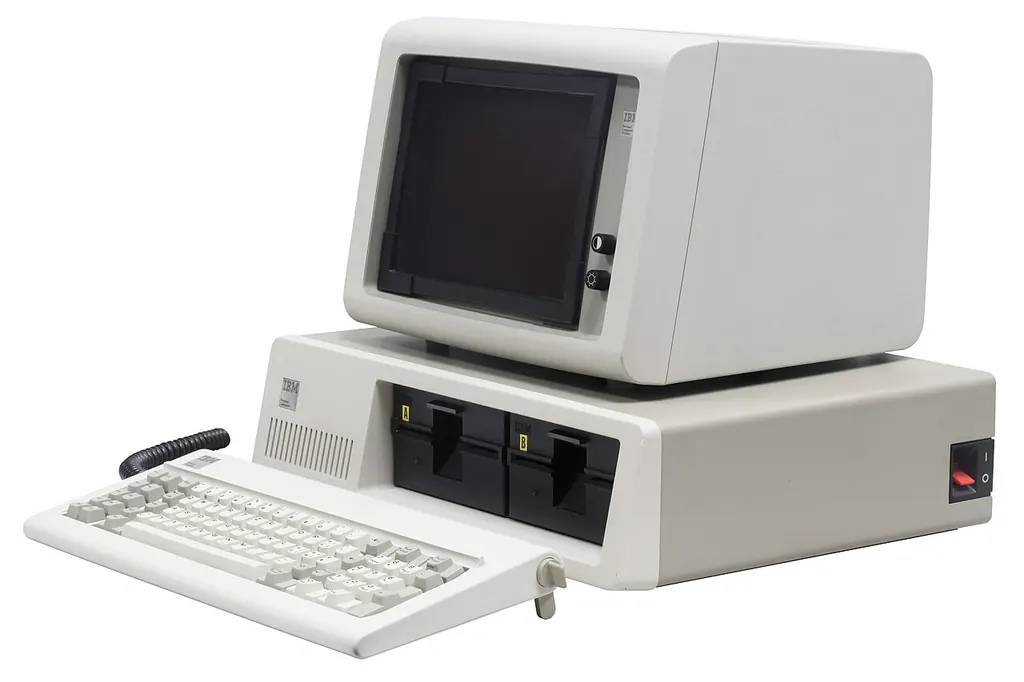
On 12 August 1981, IBM introduced the IBM Personal Computer, model 5150. A small team in Boca Raton, Florida, led by William C. Lowe and Philip Don Estridge developed it in just one year. To work this quickly, IBM used mainly off-the-shelf components and published technical documentation: an open architecture for which other companies could develop expansion cards and software.
An Intel 8088 runs at 4.77 MHz. Standard memory is 16 or 64 KB, expandable to 640 KB. Programs load from one or two 5.25-inch floppy drives, with 160 KB per side, or through a cassette port. Two graphics cards are available: the Monochrome Display Adapter (MDA) for the green-screen IBM 5151 monitor, as represented in the collection, and the Color Graphics Adapter (CGA). Microsoft supplies PC DOS, based on 86-DOS. The basic configuration with 16 KB, a CGA card and keyboard, but no drive, costs US$1,565.
The PC sold far better than expected. Only the BIOS remained proprietary; companies such as Compaq recreated it using clean-room methods, creating a huge market for compatible computers. The IBM PC standard continues to shape personal computers.
Links
Connections in the collection
Mentioned in
Keywords
Acquire the complete collection.
The collection is offered as a whole. The inventory lists show which objects are included.