Nintendo DS

Summary
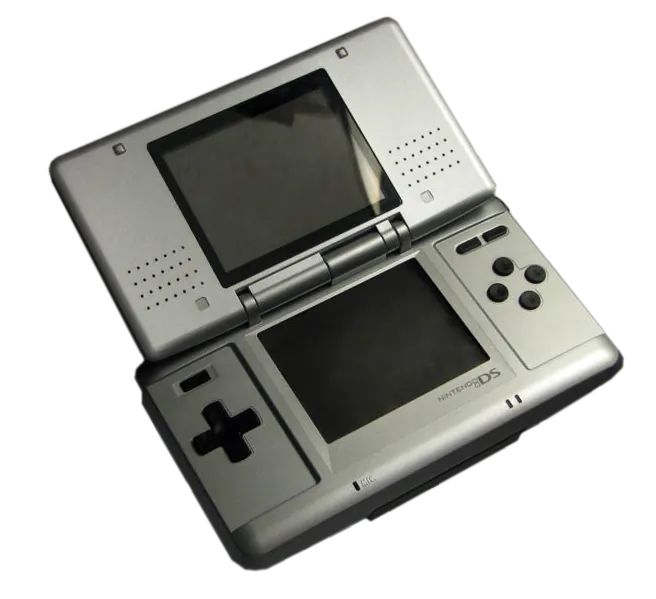
The Nintendo DS is a game console with two displays (a useful mnemonic is DS = Dual Screen, although it officially stands for “Developers’ System”) which reached the first buyers at the end of 2004. Compared to the Nintendo Game Boy, the Nintendo DS has completely new features: A screen is sensitive to touch and there is a microphone, which allows voice input. Wireless communication with WLAN allows multiplayer operation and via Nintendo Wi-Fi Connection players can play against each other online. With additional software, the DS is also present in organizer areas. The Nintendo DS does not replace the Game Boy series, but runs parallel. At the moment, however, it doesn’t look like there will be any more devices in the Game Boy series. Especially because the Nintendo DS with about 150 million units is one of the best-selling handheld consoles.
Nintendo wisely retained backward compatibility: the Nintendo DS accepts Game Boy Advance cartridges, but not those for Game Boy Color or the original Game Boy.
The Nintendo DS is available in different models. The first series with the Nintendo DS ended in 2007. It was followed by the Nintendo DS Lite, an optically revised and lighter variant. After that, the Nintendo DSi appeared with two built-in cameras, which was narrow, but omitted the Game Boy Advance cartridge slot. This is why Nintendo maintained the Nintendo DS Lite series, as it continued to offer compatibility.
Family tree
- PredecessorGame Boy Advance
- This objectNintendo DS
- Successor · not in the collectionNintendo 3DS
Sources and further links
- http://de.wikipedia.org/wiki/Nintendo_DS
- https://www.nintendo.de/Kundenservice/Nintendo-DS/Nintendo-DS-624417.html
- https://www.nintendo.de/Kundenservice/Nintendo-DSi-XL-/Nintendo-DSi-XL—301790.html
- https://www.nintendo.de/Kundenservice/Nintendo-DS-Lite/Nintendo-DS-Lite-301794.html
- http://www.planetds.de/
Connections in the collection
Software in the collection
- Nintendo DS Games and Software · 41 titles
Mentioned in
Keywords
Acquire the complete collection.
The collection is offered as a whole. The inventory lists show which objects are included.